When Your Pipeline Waits on Your Repository: Diagnosing the Silent CI/CD Tax
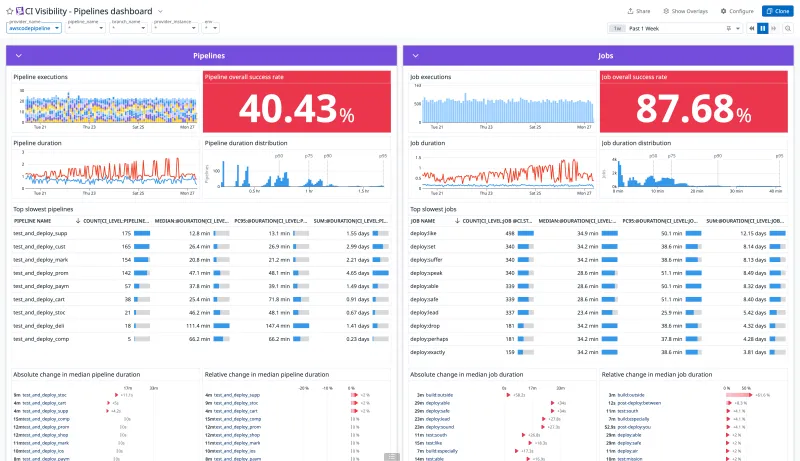
Photo: software developer monitoring CI CD pipeline dashboard on multiple screens, via imgix.datadoghq.com
There is a particular kind of inefficiency that engineering teams rarely discuss at retrospectives: the kind that hides inside the tooling everyone assumes is working fine. CI/CD pipelines slow down for many reasons—flaky tests, under-resourced build agents, bloated Docker layers—but one of the least examined culprits lives inside the version control system itself. The repository that stores your code is, increasingly, also storing your technical debt.
For teams shipping multiple times per day, even a two-minute delay per pipeline run compounds into hours of lost engineering throughput each week. Multiply that across dozens of engineers and dozens of pipelines, and the cost becomes significant. The challenge is that version control slowdowns rarely announce themselves. They accumulate gradually, triggered by habits that once seemed harmless.
The Anatomy of Version Bloat
Version bloat is not simply a matter of having too many commits. It manifests in at least three distinct ways, each of which introduces friction at different stages of the CI/CD lifecycle.
Excessive metadata accumulation occurs when teams embed version strings, build numbers, or environment identifiers directly into tracked files—configuration files, package manifests, or even source headers. Every CI run that modifies and commits these files adds a new layer to the repository's history, inflating clone times and fetch operations. On repositories with several years of such behavior, a fresh [git](https://en.wikipedia.org/wiki/Git) clone can take two to three times longer than it should.
Branch proliferation is the second vector. Feature branches that outlive their purpose, release branches that never get cleaned up, and speculative experiment branches that were abandoned after a sprint all remain in the remote repository. Most CI systems reference remote refs during pipeline initialization. A repository with 400 stale remote branches forces the pipeline runner to process ref advertisements it will never use. Teams at mid-scale companies—those in the 50-to-200 engineer range—frequently discover hundreds of branches that have not seen a commit in over six months.
Inconsistent or over-tagged histories represent the third category. Tagging every build artifact version directly in Git, rather than in a dedicated artifact registry, turns the tag namespace into a graveyard of build identifiers. Some pipelines trigger on tag creation events. Others iterate over all tags to determine the latest semantic version. In both cases, a bloated tag list introduces latency that is easy to overlook in isolation but material in aggregate.
Measuring What You Cannot See
Before any remediation effort, teams need a measurement baseline. Three metrics are worth tracking consistently.
First, repository clone time on a cold runner. Most hosted CI environments spin up fresh containers per job. The time spent cloning the repository—especially without shallow clone configurations—directly affects how quickly a job can begin meaningful work. Teams should benchmark this monthly and alert when it exceeds a defined threshold.
Second, ref advertisement latency. This is the time the Git server spends listing available branches and tags before transferring objects. It is measurable via verbose Git output and often overlooked because it occurs before the progress bar that engineers actually watch.
Third, pipeline queue-to-first-commit time. This composite metric captures the full initialization cost: spinning up the runner, fetching the repository, and reaching the first executable step. When this number climbs, version control overhead is frequently a contributing factor.
High-velocity teams that have instrumented these metrics report that repository-related latency accounts for between 8 and 22 percent of total pipeline duration in mature, unoptimized codebases. That range represents a meaningful opportunity.
A Diagnostic Framework for Engineering Teams
The following sequence provides a structured approach to identifying and addressing version control bottlenecks without disrupting active development workflows.
Step one: Audit the branch namespace. Run a report of all remote branches sorted by last commit date. Branches inactive for more than 90 days are candidates for archival or deletion. Establish a branch lifecycle policy—ideally enforced at the platform level—that automatically closes branches after merge or after a defined dormancy period.
Step two: Evaluate shallow clone eligibility. Most CI jobs do not require the full commit history of a repository. Configuring --depth=1 or a defined depth appropriate to your changelog generation tooling can reduce clone time by 60 to 80 percent in repositories with long histories. Validate that your pipeline steps—particularly those generating release notes or computing version increments—are compatible with shallow histories before applying this broadly.
Step three: Migrate version metadata out of tracked files. Build numbers, deployment timestamps, and environment-specific configuration values should live in CI environment variables or a dedicated secrets and configuration service—not in committed files. This eliminates a class of automated commits that pollute history and inflate repository size over time.
Step four: Consolidate your tagging strategy. Agree on a single, semantic versioning convention and enforce it through automation. Remove legacy build tags from the remote namespace, migrating artifact version records to your artifact registry. Tools such as AWS CodeArtifact, JFrog Artifactory, or GitHub Packages are purpose-built for this responsibility.
Step five: Implement periodic repository maintenance. Large repositories benefit from regular git gc operations and, in extreme cases, history rewrites using tools like git-filter-repo to remove large binary files that were committed and later deleted but remain in the object store.
The Compounding Cost of Inaction
The version control tax is not static. Every week that a team continues its current practices, the problem grows. A repository that takes 45 seconds to clone today may take 90 seconds in eighteen months without intervention. That trajectory, applied across an engineering organization's entire pipeline fleet, represents a material investment in waiting.
More importantly, slow pipelines erode the feedback loops that make continuous delivery valuable. When engineers wait longer to learn whether their changes are valid, they batch more work between feedback cycles, which increases the cognitive load of debugging failures and the risk surface of each deployment.
Version control is the foundation on which modern software delivery is built. Treating it as infrastructure—something that requires active maintenance, measurement, and optimization—rather than as a passive utility is one of the highest-leverage habits an engineering organization can develop. The teams shipping fastest are not necessarily the ones with the most sophisticated pipelines. They are the ones who have removed the most friction from the tools everyone else takes for granted.